

EchoId brings together the data needed for a Digital Product Passport (DPP). Built around standardised APIs, the platform collects relevant product information and makes it accessible in line with legislative requirements.


Your DPP data in one place
EchoId provides a central hub with a user-friendly interface for managing and reviewing your DPP data. Standardised APIs connect your systems for seamless management of the required product information.
Data from your PIM, ERP, PLM or other systems is brought together in EchoId to create each product’s Digital Product Passport and share information with relevant stakeholders.
You can also store selected data directly in the platform.
Connecting the physical product to its digital passport
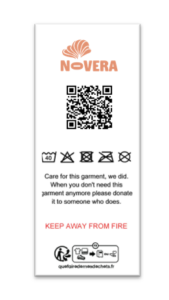
EchoGenerator creates the physical data carrier for your Digital Product Passport, such as a QR code printed on a care label or applied to the garment as a heat transfer.
Seamless integration between our modules allows information to be shared automatically, keeping your workflow simple and efficient.
Much of the information needed for your DPP can be drawn directly from the care label data and transferred automatically to EchoId and the product’s digital passport.
A consumer experience that reflects your brand
EchoId also creates the consumer-facing part of your Digital Product Passport.
You control how the passport is presented to consumers, including the relevant information defined by DPP legislation.
We help you build a consumer interface designed to meet DPP requirements while creating opportunities to engage with your customers and express your brand identity – right down to the digital label.
Three modules for flexible, efficient workflows
Together, EchoGenerator, EchoId and EchoQ-Route provide the tools to manage and administer upcoming Digital Product Passports.
Our modular approach gives you the flexibility to make different parts of the production workflow accessible to the relevant stakeholders, supporting efficient collaboration.
We closely follow legislative developments and build in line with available standards and guidance to help you prepare as the regulatory framework takes shape.
The textile industry’s biggest regulatory shift in decades
The EU’s Digital Product Passport is part of the European Green Deal and the EU Strategy for Sustainable and Circular Textiles. It forms part of the Ecodesign for Sustainable Products Regulation (ESPR), which entered into force in July 2024.
The goal is for all textiles placed on the EU market to be sustainable, traceable and circular by 2030, with consumers and authorities able to access information about a garment’s entire lifecycle through a QR code or another data carrier.
The textile-specific requirements, set out in a delegated act, are expected to be finalised in late 2026 or early 2027, followed by a transition period of approximately 18 months before they become mandatory.
Brands should therefore start putting their data collection processes and labelling structures in place now, even while the detailed requirements are still being developed.
The EU’s ambitions can be summarised in five goals:
• Extend the lifespan of textile products.
• Make more products repairable, reusable and recyclable.
• Increase the proportion of recycled fibres in products.
• Reduce or eliminate hazardous substances.
• Bring fast fashion to an end and turn textile waste into new resources.
The path to mandatory requirements
The timeline below reflects the European Commission’s latest published information as of August 2026.
| Year | Milestone |
|---|---|
| 2022 | 2022 The EU Strategy for Sustainable and Circular Textiles is adopted. |
| July 2024 | ESPR enters into force, establishing the legal framework for Digital Product Passports. |
| 19 July 2026 | The European Commission’s central DPP registry, established under Article 13 of ESPR, is expected to go live. |
| Late 2026 / early 2027 | The delegated act setting out textile-specific DPP requirements is expected to be finalised. |
| 2027–2028 | An approximately 18-month transition period before the requirements become mandatory for textiles. |
| 2027–2030 | Full rollout of DPP requirements across additional sectors, including stricter requirements for medium-sized companies. |
| 2030 | Target: all textiles on the EU market are sustainable, traceable and circular. |